
THE PROBLEM
Our initial calls with Kevin revealed the issues:
- Amazon was treated as a secondary channel
- Prior agencies caused compliance issues and listing damage
- PPC spend increased without structural clarity
- Strong products, weak conversion leverage
- No clean SKU-level profitability visibility
Which usually means one thing:
The foundation wasn’t built to scale safely.
THE STRATEGY
Instead of “optimizing campaigns,” we rebuilt the system PPC depends on.
Which tells me the correct order was:
CRO ? STRUCTURE ? SCALE
CORE DECISIONS
- Pause broad scaling until CTR and USP stabilized
- Rebuild listings for clarity, compliance, and buyer confidence
- Engineer main images to improve click-through at high CPCs
- Restructure PPC portfolios by SKU and intent
- Separate branded vs non-branded traffic cleanly
- Scale only proven SKUs with measurable ROAS
PPC performance is strongly affected by CTR (main image) and Unit Session Percentage.
So creative and listing clarity came first.
THE EXECUTION
? Re-architected PPC portfolios to isolate profitability by SKU
? Cleaned legacy campaigns that were inflating spend without learning
? Tightened keyword intent to reduce CPC bleed
? Directed conversion-first creative updates (hero + image stack)
? Increased spend only where conversion signals justified scale
? Maintained ROAS discipline while expanding impression share
This was controlled scaling — not budget inflation.

FROM “ADS RUNNING” ? PROFITABLE PPC SCALE
Before this engagement, PPC performance existed — but it wasn’t compounding.
Reading between the lines of the early data:
- Pre-April PPC sales hovered around $30K–$40K/month
- Spend was cautious
- Growth was flat
- Scaling felt risky
That usually means the system can’t support more traffic.
AFTER THE REBUILD
Once CRO, listing clarity, and portfolio structure were fixed:
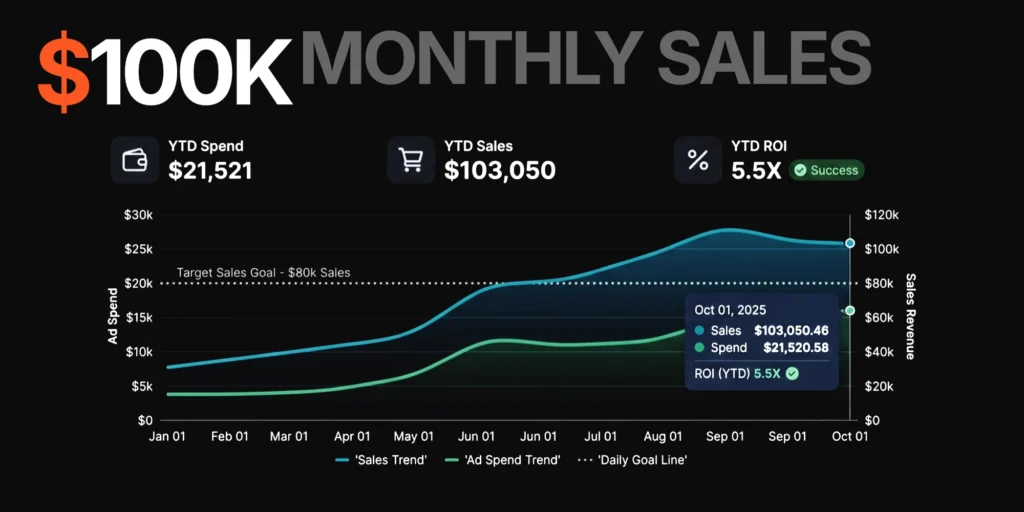
- April became the inflection point — ~$49K PPC sales on ~$8K spend
- By mid-year, PPC sales climbed into the $70K–$90K/month range
- By October, PPC crossed ~$100K/month
- ROAS held ~5.5+ throughout the ramp
WHAT ACTUALLY CHANGED
- Spend no longer led decisions — data did
- Scale followed SKU-level proof
- CTR and conversion supported higher CPCs
- PPC became predictable instead of fragile
This wasn’t a budget increase.
It was a capacity increase — the account could finally absorb scale without breaking.
FROM VOLATILE DAYS ? CONSISTENT REVENUE FLOOR
Before the rebuild, sales existed — but they weren’t dependable.
Looking at the early months:
- Monthly revenue hovered around $30K–$40K
- Daily sales were inconsistent
- Strong days were followed by sharp drop-offs
- Performance felt reactive instead of controllable
That’s usually a sign that traffic is leaking — not converting.
THE INFLECTION
As conversion issues were addressed and PPC traffic quality improved:
- Mid-year monthly revenue moved into the $70K–$90K range
- Daily sales became steadier instead of spiky
- Volume increased without needing aggressive spend jumps
This is where predictability starts — not at the peak.
THE STABILIZED STATE
By late summer into early fall:
- Monthly revenue consistently crossed $100K+
- $7K–$10K sales days became repeatable, not occasional
- Downside volatility compressed — bad days weren’t catastrophic
At this point, Amazon stopped behaving like a test channel
and started acting like an operating revenue stream.
WHAT ACTUALLY CHANGED
This wasn’t about “more traffic.”
- Listings stopped leaking demand
- Conversion rates stabilized under higher load
- PPC no longer had to overcompensate for weak pages
- Spend supported momentum instead of chasing it
Which is why the floor moved up — and stayed there.
FROM BLENDED PPC CHAOS ? SKU-LEVEL PROFIT CONTROL
Before the rebuild, PPC activity existed — but clarity didn’t.
Looking at the early structure:
- Campaigns were blended across multiple SKUs
- Branded and non-branded intent overlapped
- Spend was hard to attribute cleanly
- Decisions were made at the account level, not the product level
That usually means scale feels risky — because no one knows what’s actually driving profit.
THE INFLECTION
As portfolios were restructured and intent was separated:
- PPC was broken out by SKU and intent
- Branded vs non-branded traffic became visible
- Orders and ROAS could be tracked meaningfully
- Underperforming spend was isolated instead of hidden
This is where control replaces guesswork.
THE STABILIZED STATE
Once structure and tracking were in place:
- 5,600+ PPC-attributed orders were cleanly tracked
- Profitable SKUs were scaled without subsidizing losers
- Spend cuts could be made surgically — not emotionally
- PPC decisions became repeatable, not reactive
At this stage, PPC stopped being “managed”
and started being operated.
WHAT ACTUALLY CHANGED
This wasn’t about better keywords.
- Portfolio architecture reflected how profit actually worked
- Scaling decisions were SKU-led, not dashboard-led
- Winners absorbed budget without distortion
- Losers were capped without killing momentum
Which is why efficiency held as volume increased.
FROM HIGH CPC PRESSURE ? CRO-LED PROFITABILITY IN A PREMIUM CATEGORY
This account operates in a difficult environment:
- Automotive category
- High CPCs
- Technical products
- High buyer scrutiny
- $130+ average order value
Before the rebuild, PPC performance depended on restraint.
Looking at the early state:
- CPCs were high relative to category benchmarks
- Scaling felt dangerous — every click was expensive
- Conversion inefficiencies were amplified, not hidden
- PPC had to compensate for unclear listings
In high-CPC categories, that’s how margins disappear.
THE INFLECTION
Instead of fighting CPCs, the strategy shifted to absorption.
As CRO and listing clarity improved:
- Main images were engineered to earn the click
- Listings reduced buyer hesitation upfront
- Traffic quality improved — not just volume
- Higher CPCs became sustainable instead of painful
This is where most PPC-only strategies break — and where this one started working.
THE STABILIZED STATE
Once conversion could support the traffic cost:
- PPC scaled without margin collapse
- 5.5+ ROAS held despite competitive bids
- Premium AOV worked with PPC, not against it
- Spend could increase without fear of efficiency loss
At this point, CPCs stopped being the constraint.
Conversion capacity became the lever.
WHAT ACTUALLY CHANGED
This wasn’t a bidding strategy.
- CTR absorbed rising CPCs
- Conversion rates carried expensive traffic
- Listings did the heavy lifting PPC can’t
- PPC amplified a system that could convert
Which is why performance held under pressure.